
(Note: the tarot illustrations from Pamela Coleman Smith are in the public domain. For this page, they are sourced from Wikimedia Commons. The photograph above is my own.)
In part II of this series on reading the tarot, we took a closer look at the Suit of Swords, representing the painful realizations that often go hand in hand with gaining insight and clarity. Swords tell a bleak story, but it’s one we need to hear in order to clear the way for more productive pursuits. If you haven’t read parts I and II, I definitely recommend that you read them before moving on to the Suit of Wands. Just like with Swords, I’m going to go through each card in the suit and talk about what it represents, what role it plays in the suit’s story, and some keywords and affirmations to go with it. You can use this information for reference in your own readings in whatever ways you find appropriate.
The Suit of Wands
As a suit, the cards of Wands (in some decks called rods, bows, or staves) represent something that is similar to Swords, yet also very different. While the Sword is double-edged and can cut for good or evil, the Wand is something altogether different. A sword is meant to be a weapon; the choice of how that weapon is used is in the hand of the one who wields it, but as an object, a sword has no practical use except as a weapon. A wand (which, in the context of the tarot, usually refers to a slender staff as opposed to the baton-like item most people associate with fictional witches and wizards) isn’t sharp at all, and unlike a sword, which can only be a weapon, a wand has many uses. It can be a weapon, but it can also be leaned on for support, or used as a tool to build shelter, or rubbed against another to make fire.
In many ways, the story of the Suit of Wands mirrors the Suit of Swords, but is much less grim. It speaks of conflict just like the Swords do, but it speaks of conflicts that are constructive rather than destructive. It has moments of peace like the story of Swords, but this time they are moments of genuine joy instead of merely moments to catch the breath. Its ending isn’t a particularly happy one, but neither is it bleak and hopeless like the Ten of Swords. In some ways, if we treat the Minor Arcana as one story instead of four separate ones, the chapter of Wands tells what happens when the hero has learned lessons from what happened to him in the chapter of Swords, and is determined to do better this time around.
Where Swords are governed by thoughts and insight, Wands are governed by actions and passion. They represent the querent’s willpower and desires, and encourage you to explore how far you are willing to go to achieve your goals, and to get back up and keep moving when you encounter setbacks. They are ruled by the element of fire, and represent summer and the south. Now we will take a closer look at each card in the Suit of Wands.
The Ace of Wands
Keywords: Creation, Inspiration, Desire
 Waite-Smith imagery: A
wooden wand is held directly upright. Like the other aces, it is
held by a hand emerging from grey clouds. While the sword in
the Ace of Swords is held by a left hand, the hand holding the wand
is a right
hand. The wand is made of rough-hewn wood, still living: green
leaves sprout and fall from its sides. In the background, a castle
sits on a hill overlooking a green, fertile valley. A river runs
through the valley, with majestic mountains and a bright sky behind
it all.
Waite-Smith imagery: A
wooden wand is held directly upright. Like the other aces, it is
held by a hand emerging from grey clouds. While the sword in
the Ace of Swords is held by a left hand, the hand holding the wand
is a right
hand. The wand is made of rough-hewn wood, still living: green
leaves sprout and fall from its sides. In the background, a castle
sits on a hill overlooking a green, fertile valley. A river runs
through the valley, with majestic mountains and a bright sky behind
it all.
Concept: The Ace of Wands is the moment when thought becomes will. It is the spark of potential, and the raw materials of the craft. With a good staff to lean each step into, you can travel to that shining castle on the distant hill, while passing through the delights of the green country between you and your destination. You have a fine, sturdy branch; what will you make from it? Will you craft an ornate walking stick? A quarterstaff to defend yourself and clear the path? A firebow to keep yourself warm? This is the impetus to put things in motion; all of the raw potential energy is there in your hand. It is up to you how you will channel it.
In a reading: To see the Ace of Wands in a reading is to have a flash of inspiration and a desire to make things happen. It could be a sudden insatiable feeling of creativity. It could represent a new hobby you’ve just started, or perhaps it’s even your encouragement to take up that new hobby you’ve been thinking about but haven’t been confident enough to dive into yet. It could be the gentle nudge you need to stop putting off that project you’ve wanted or needed to do. The goal you’re trying to reach may be far away, but the journey is often just as pleasant as the destination.
A helpful focusing affirmation: “The power of creation is in my hands. I choose to turn my inspiration into action.”
The Two of Wands
Keywords: Planning, Potential, Choice
 Waite-Smith imagery: A
man dressed in fine clothes stands, his back to the viewer, on a
crenellated stone rampart overlooking a village, a green forest, the
sea, and mountains in the distance. In his left hand, he holds a
wooden staff vertically, grounding the butt of the staff on one of
the merlons, which is engraved with an image of roses and lilies.
Another staff is affixed with a metal band to the side of the crenel
on the man’s right. Both
staves sprout green leaves. The
man ponders or examines the globe of the earth held in his right
hand.
Waite-Smith imagery: A
man dressed in fine clothes stands, his back to the viewer, on a
crenellated stone rampart overlooking a village, a green forest, the
sea, and mountains in the distance. In his left hand, he holds a
wooden staff vertically, grounding the butt of the staff on one of
the merlons, which is engraved with an image of roses and lilies.
Another staff is affixed with a metal band to the side of the crenel
on the man’s right. Both
staves sprout green leaves. The
man ponders or examines the globe of the earth held in his right
hand.
Concept: The castle wasn’t as distant as you thought. You now look down from its battlements and see the land spread out before. The walls of this fortress are safe, but confining, and you hunger to see more than this tower can show you. The emblem of crossed lilies and roses acts as a reminder that you can find balance between the strength of your desires and the wisdom of acting on them. You don’t just hold a map in your hand: it’s a globe of the world. All of it, right there in the palm of your hand. You want to see it all – but you remember the pain of the Swords, and you know that to do that, you will have to leave the safety of the tower. But fear of failure won’t hold you back; this is a time to be decisive, but not reckless. The journey to the castle taught you some of your potential, and now it’s time to think on how you will make the journey to see the rest of the world beyond.
In a reading: Like the Two of Swords, the Two of Wands represents a crucial choice. This time, though, it usually doesn’t point to indecision or the difficulty of the choice; instead, it usually calls attention to a decision you have made, and subtly cautions you not to rush off blindly in pursuit of that goal. Take time to plan and look before you leap, but dream big; the potential is there. You may not know yet how your grand ambitions will bear fruit, but this card is telling you that they won’t bear fruit unless you pursue them – carefully, but decisively.
A helpful focusing affirmation: “I allow myself to have grand designs, and I choose to not let them remain mere visions.”
The Three of Wands
Keywords: Expansion, Growth, Forethought
 Waite-Smith imagery: A
man in fine clothes stands on a cliff overlooking the sea, his back
to the viewer. Two staves are planted behind him in the ground on
either side. He holds a third staff in his outstretched right hand,
grounding it firmly. Ships sail serenely on the golden, sunlit bay,
and purple mountains rise from the distant horizon under a golden
sky.
Waite-Smith imagery: A
man in fine clothes stands on a cliff overlooking the sea, his back
to the viewer. Two staves are planted behind him in the ground on
either side. He holds a third staff in his outstretched right hand,
grounding it firmly. Ships sail serenely on the golden, sunlit bay,
and purple mountains rise from the distant horizon under a golden
sky.
Concept: There was some hesitation while you stood on the battlements, but now that you’ve left the safety of the tower, the world spreads out before you. There’s so much to see and do; so many ways you could get there. You’ve made the decision to go. The “what” and “where” are no longer in question for you – only the “how.” You’ve made some plans already, but now that you’re actually on your journey, your plans expand and your expectations grow even further. Ideas supplement your grand plan, but you ground your staff and lean on it so that you don’t tumble over the cliff edge by getting ahead of yourself.
In a reading: The Three of Wands represents the transition that occurs when an idea leaves the abstract and begins to come together as a material reality. When you see it in a reading, you may be satisfied with the path you’re currently walking, but not necessarily willing to be confined to that path. This card is about expansion and growth – not necessarily in the sense of maturation, but in the sense of focusing on how to get the most out of your plans. The field will grow on its own once planted, but it will yield even more fruit if you also fertilize it and pull the weeds. This isn’t about making plans; you’ve already done that. This is about refining your plans now that you can see more of the big picture from the perspective of someone on the ground.
A helpful focusing affirmation: “The small adjustments I make now may have a profound effect for good or ill on my success later, so I walk this path with care.”
The Four of Wands
Keywords: Celebration, Community, Foundation
 Waite-Smith imagery: Four
staves are stood upright from the ground. They hold a garland of
flowers and leaves, forming something like an arch. Behind the arch,
two robed figures approach, their hands upraised in celebration and
holding bouquets of flowers. A crowd of other people appears in the
distance behind them. In the background, a grand castle sits beneath
a bright golden sky.
Waite-Smith imagery: Four
staves are stood upright from the ground. They hold a garland of
flowers and leaves, forming something like an arch. Behind the arch,
two robed figures approach, their hands upraised in celebration and
holding bouquets of flowers. A crowd of other people appears in the
distance behind them. In the background, a grand castle sits beneath
a bright golden sky.
Concept: The people of your community saw you embrace and set off on your journey, and they celebrate your grand vision, forming a triumphal procession to support you in your endeavors. They stand ready to go on the journey with you. It is a joyous moment: a lone person becomes two, then two become four or five, then four or five become nine or ten, then nine or ten become many. Now you don’t have to make the journey alone, for many can share in it. They know that your success is also their success, and that is worth celebrating.
In a reading: The Four of Wands is an encouraging card to see in a reading. Usually, this card symbolizes reaching some kind of milestone. Your intention probably isn’t complete yet, but this card is a good prompt to stop for a moment and reflect on the successes you’ve seen so far in pursuing it, especially the successes that are shared and/or celebrated by the people who are close to you (and perhaps even by the broader circles you’re part of). You will have to continue walking the path, but stopping to celebrate your progress is important so that you stay motivated to continue going forward. Look at this as an opportunity both to celebrate what you’ve accomplished so far, and to gather your allies so that you can climb to even greater heights; the stronger support network you can build, the better distributed the weight of your responsibilities will be.
A helpful focusing affirmation: “I can pause to take pride in my success without taking my eyes off of my larger goals.”
The Five of Wands
Keywords: Competition, Conflict, Rivalry

Waite-Smith imagery: Five people grapple with one another with their staves under a clear blue sky. All of the figures wear different colors and stand on uneven ground. They don’t appear to be landing blows on one another; indeed, from their facial expressions, it’s unclear whether they are even focused on fighting one another in the first place, since they appear to be looking past each other rather than looking at each other.
Concept: The celebration of the Four of Wands was short-lived, just like the respite of the Four of Swords, and once again you find yourself embroiled in conflict. This time, however, it’s not a fight to vanquish your enemies, but rather a disagreement with your companions. You have laid out a grand vision, but everyone thinks they are the one who knows the best way forward. The journey made perfect sense to everyone when it was just lines on a map, but sometimes fallen trees block the road, and not everyone agrees on how to clear the path. You all have a common goal, but you disagree on how to achieve it.
In a reading: When you see the Five of Wands in a reading, you probably already know that there is some kind of problem you have to solve, and there is some disagreement on how to solve it. This may be disagreement with your friends or life partners, disagreement with your coworkers, or maybe even disagreement between competing ideas in your mind. The Five of Wands is not a card to be feared; disagreements are an inevitable part of strong relationships, because they represent the fact that everyone has something different to bring to the table. Take all different perspectives into account; your way might ultimately be the right way (or it might not), but there is value in listening to what your allies have to say, even if you don’t believe they’re right – that is how you build understanding.
A helpful focusing affirmation: “Not every disagreement is a threat to my goals; they can be opportunities for growth if I listen to learn rather than to respond.”
The Six of Wands
Keywords: Confidence, Pride, Success

Waite-Smith imagery: Under a clear blue sky, a rider with a red cloak and laurel crown sits confidently astride a pale horse caparisoned in blue and green, and he holds a staff upright. A laurel wreath adorns the top of his staff. Other figures march beside him with five staves of their own, some looking forward, some looking up at the rider.
Concept: The disagreement was resolved peacefully, and your companions now recognize that your vision is the best way forward, and they once again hail you as their leader. You’ve listened to all the different perspectives, integrated them into your grand plan as appropriate, and now triumphantly lead everyone along the journey, harmony restored. You know you are right, you believe in what you are doing, and you’ve convinced everyone to remember the successes that led them to join you in the first place.
In a reading: Like the Four of Wands, this card often signifies a milestone successfully reached. Unlike the Four, however, the Six specifically points to the fact that you have overcome some challenge and emerged in triumph. Taken narratively with the Five of Wands, it represents not just any success, but specifically the successful resolution of conflict in your favor. The laurels on the card signify the fact that this is not just a success or victory of some kind, but specifically one that has gained the recognition of others, something that can give you pride and confidence. The forward march also carries a subtle note of caution not to rest on those laurels, since there is more work to be done ahead.
A helpful focusing affirmation: “I do not need the validation of others to know the worth of my success, but it is still to my benefit to earn their respect.”
The Seven of Wands
Keywords: Perseverance, Courage, Control
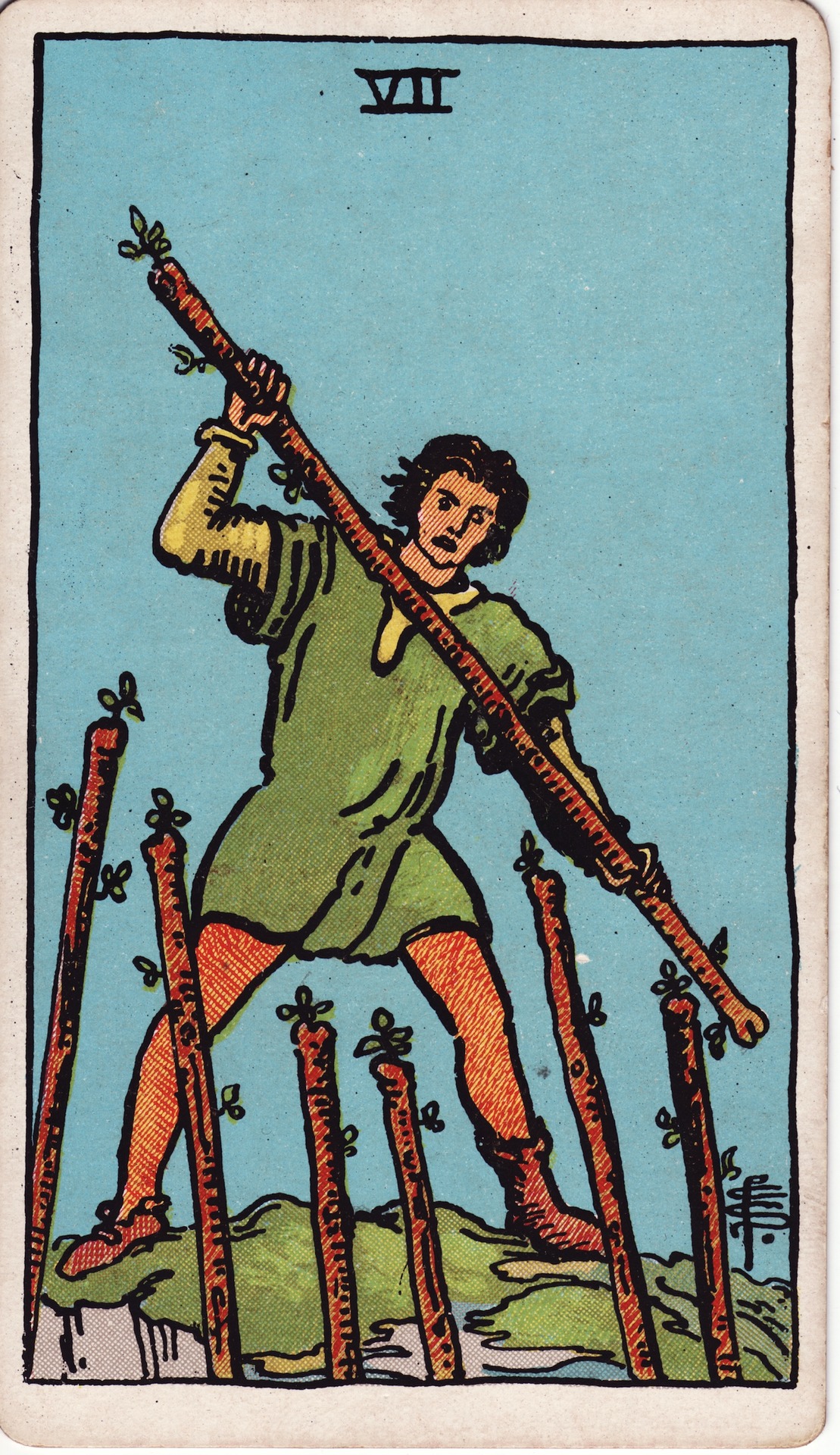
Waite-Smith imagery: A man with a frightened expression stands looking down from the edge of a precipice under a clear blue sky, defensively holding a staff in front of him. He wears mismatched boots, as if caught unprepared during the climb. Six other staves are raised from below in front of him as if in challenge.
Concept: You convinced everyone that your way forward was best, and they followed you. Now, though, you’ve had to make a steep climb up high, rocky ground, and the people following you are angry, believing you’ve led them astray. They no longer follow you, but now challenge you from behind. The way forward is clear, but you have to turn around to fend off attacks from behind. They followed you when the way was easy, but they never agreed to this. Now you have to face the prospect that you may have to continue this journey alone, but you don’t shrink back, and you hold to your courage.
In a reading: When you see the Seven of Wands, it is a good time to reassess your intention and your commitment to it; this card represents the idea of persevering and maintaining control in the face of adversity, even when that adversity comes from your allies. As badly as you may want them with you, they might be holding you back if they are not willing or able to meet challenges the way you are. If you truly believe in what you are doing, you should be willing to see it through to the end and not back down when the way forward becomes rocky. Being willing to listen to other perspectives doesn’t mean that you have to give up your passions or your ambitions in order to satisfy them.
A helpful focusing affirmation: “I believe in what I am doing, and I will maintain that belief and stand up for myself, even if it means I have to stand up to my friends.”
The Eight of Wands
Keywords: Haste, Travel, Progress
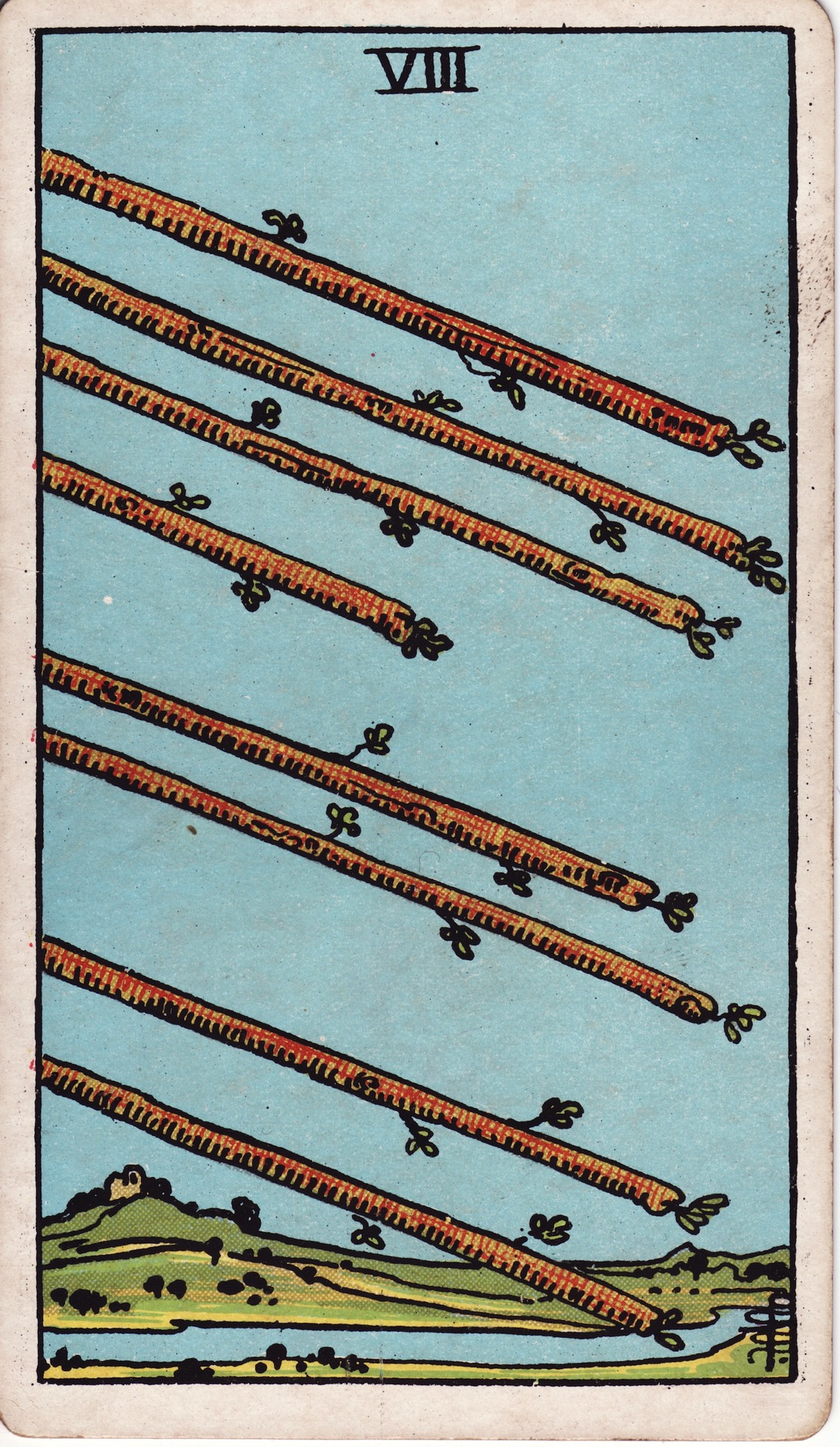
Waite-Smith imagery: Eight wooden staves fall from the viewer’s left side (rightward and downward) against a clear blue sky, and a view of a green valley with a river running through it and a far-distant castle on a hill that rises behind the river. Worthy of notice is the fact that this is one of only two cards in the Minor Arcana (the other being the Three of Swords) for which no part of any human figure appears anywhere in the illustration.
Concept: You’ve lost the support of the people who once followed you, but in doing so, you’ve also shed their burdens. They drop their staves and go back the way they came, unwilling to make the hard climb. You, on the other hand, made the climb, and now you stand on top of the distant purple mountains you first saw in the Ace of Wands. You did it: you made the journey. But you see the staves your friends left behind now lying on the ground, and it reminds you that it came at a cost. Now it’s a downhill climb from here, unburdened by conflict with traveling companions, and you can look back over that green valley and see just how far you’ve come – the castle and its familiar comforts are much further away than when you first saw them, but that just goes to show how much you’ve progressed along your journey. With your supporters no longer with you and your plan complete, you now have to find your own way home, and soon.
In a reading: There is a sort of urgency to this card; it represents the idea of travel and progress. When you go somewhere, you may be feeling the excitement of getting there, and when your time there is done, you are likely eager to be back home in familiar, comfortable surroundings. When you stand on the mountaintop and look back at how far you’ve come, it often comes with the realization that the journey itself mattered much more than the destination. When you see this card in a reading, consider the parts of your life that might have stagnated and what you might need to do to get things moving again.
A helpful focusing affirmation: “My progress is faster when I shed the burdens that no longer make sense for me to keep carrying.”
The Nine of Wands
Keywords: Resilience, Grit, Stubbornness

Waite-Smith imagery: Eight wooden staves stand vertically from the street. A man wearing a bandage around his head looks back at the staves somewhat pensively while leaning forward on a ninth staff of his own. Green hills stand in the distance, all under a clear blue sky.
Concept: You’ve nearly made it home. The road hasn’t been an easy one, and you haven’t made it through the journey completely unscathed and uninjured. You’ve overcome every obstacle up to this point, but the passion that you started with has dulled, and you’re not as confident coming home as you were setting out. You’ve overcome conflict, but you continue to carry the reminders of those conflicts – and what they cost - with you on your journey. You could lay those burdens down or set them aside, but the way you see it, you’ve done things your way all the way there and back again, so you can’t see any reason to change now. One final push will take you through to the end of the journey.
In a reading: The Nine of Wands represents resistance, of a sort – not necessarily in the sense of conflict with others, but in the sense of resistance to change. If you see it in a reading, consider what areas in your life may have you digging in your heels and refusing to compromise, but also consider whether that is the correct course of action. Contrary to the social expectations that are often presented, compromise is not always the wisest course of action, especially when you are making a last stand and have nothing to lose. What your adversaries may decry as stubbornness may actually be resilience on your part, but it’s important that you consider that distinction with a clear mind. Holding onto an idea simply because of sunk cost is rarely worth the gain, but holding onto an idea because it is right is always the right choice. It’s better to fail while pushing too hard than to fail while holding back; if you push too hard and still fail, at least you know you’ll have given it your best. If you’re sure you’re making the right choice, stand your ground to the last.
A helpful focusing affirmation: “When I know my course of action is the right way, I call on all of my willpower and energy to see it through.”
The Ten of Wands
Keywords: Accomplishment, Burden, Obligation

Waite-Smith imagery: A man walks forward, his back to the viewer, down a street and towards a castle that sits in the background. He carries a bundle of ten staves, and he is hunched over as if weighed down by what he carries. Behind the castle are green trees and countryside, all under a clear blue sky. Afternoon sunlight gives the elements of the scene a warm tone.
Concept: The journey of the wands is now complete; you’ve reached your goal, but it requires you to carry a heavy weight. This is a responsibility you chose for yourself, in a way; the burden was lighter in the beginning when it was shared among your traveling companions, but your insistence on doing things your way – even if your way was the right way – meant that by the end, you had to carry the weight alone. You succeeded, but the heaviness of your success takes some of the joy from it. Still, you feel accomplished: unlike your undertaking of the journey of swords, which left you in utter ruin and defeat, this time you met your goals. Your passion and willpower saw you through, though not without some sacrifice and labor.
In a reading: When you see the Ten of Wands in a reading, it’s often a sign to assess which responsibilities you are carrying, especially those that you could defer to others. It could be that you have a hard time telling people, “Sorry, I can’t,” or it could be that you took on a project or role without realizing how much would be involved in completing or fulfilling it. This card has a sort of duality to it; on one hand, it represents the success of a job well done. On the other hand, it represents the weight of obligation, especially obligations that you took upon yourself. The only way to proceed is to either learn how to carry that weight forward, or reassess whether you should be carrying it at all.
A helpful focusing affirmation: “I rely on my passions to fulfill my goals, but I also discern between my own responsibilities and those of others.”
The Page of Wands
Keywords: Freedom, Excitement, Inspiration

Waite-Smith imagery: The Page stands in the desert, looking excitedly at the tip of the staff he holds, as if fascinated by the leaves that sprout from it. He wears a grey hat with a red feather, covering curly locks of golden hair. He wears a tunic printed with a pattern depicting a salamander chasing its own tail, along with a bright yellow cape. Behind him are sand dunes under a clear blue sky.
Concept: Just as in the other three suits of the Minor Arcana, the court cards of Wands represent the maturation of their key aspects, and the Page in particular is the first spark that matures into a powerful fire. The Page doesn’t hold his staff like a weapon, but instead looks at it excitedly as if seeing its many potential uses. As the suit of Wands is the wildfire of passion and will, the Page is embers falling on dry grass; for passion and will to lead anywhere, they need inspiration to form, excitement to motivate, and freedom to move.
In a reading: Like the other Page cards of the tarot, there’s a sense of anticipation in the Page of Wands. Ultimately, this card is about not just energy and excitement, but a zest for life. When you see it, think about some of the projects you’ve been thinking about doing, or a trip you’re thinking of taking, or any number of the things that have led you to say “some day I will…” This is a good reminder to not let fear of failure stop you from trying new things; maybe you have dozens of unfinished projects that you started and thinking of those things is holding you back. Don’t let it. If you’ve got an idea to bring into the world, do it. Make it exist first; you can make it look nice later.
A helpful focusing affirmation: “I refuse to allow the hardships in my life to dampen my sense of wonder and excitement for new things.”
The Knight of Wands
Keywords: Action, Energy, Fearlessness
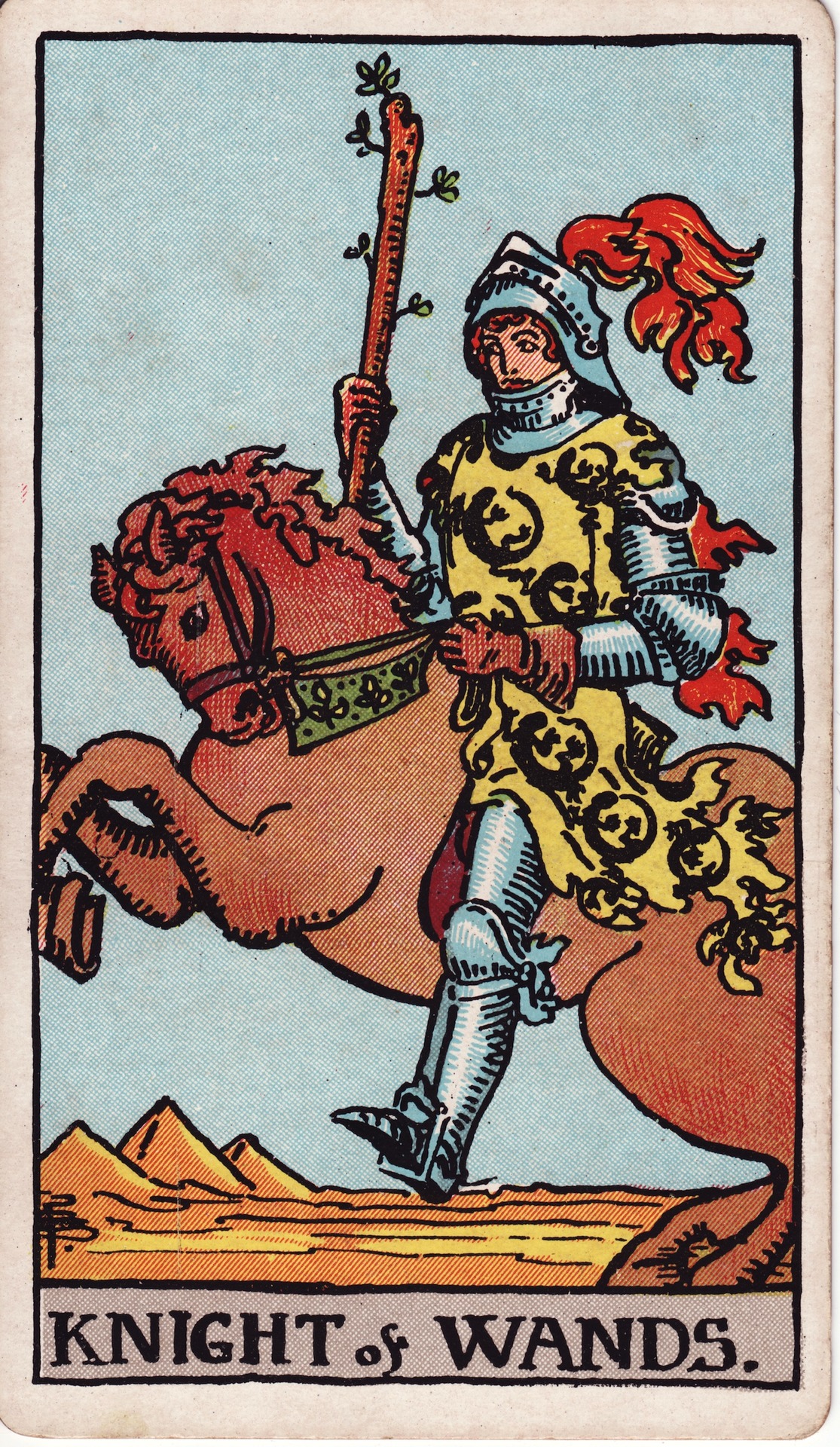
Waite-Smith imagery: A rider in armor holds a staff upright in his right hand, and holds the reins of his sorrel (red) horse in his left. The horse rears, and the Knight has a wide-eyed countenance. The Knight wears a yellow tabard patterned with the image of a salamander chasing its own tail, and his helmet has a plume of bright red feathers. He rides through a desert landscape with sand dunes in the background, all under a clear blue sky.
Concept: The spark of excitement seen in the Page of Wands has matured into the energy of action. This knight is fearless; he has the passion and the drive and will to pursue it, and will do so at any cost, like the valiant heroes in stories of old. However, though there is now action paired with inspiration, there is also still a certain lack of discipline. The Knight of Wands is still trying to charge ahead, but unlike the Knight of Swords, he is struggling to control his mount. This is often the way of our passions: they sometimes take us for an uncontrolled ride. We can’t truly go anywhere without passions, but we don’t always go where we want even with them. The Knight’s horse is rampant, warning him of the dangers ahead, but he tries to force it forward even so.
In a reading: The Knight of Wands represents many of the same things as the Page does, but to greater degrees: freedom has become impulse, inspiration has become boldness, and excitement has become impatience. This card could be interpreted in several different ways depending on what’s going on in your life; like all the other Knights, it could be read either as a spur to action or as a note of caution. Seeing this card in a reading may mean that it’s a good time to stop thinking so much and start doing. On the other hand, it could also mean the opposite: you may be charging ahead and leaving a mess that others will have to clean up. In either case, as a warning, the Knight of Wands is less about stopping your progress and more about considering the consequences (to yourself and others) of what you’re doing. This card doesn’t mean you should stop or back down from challenges – quite the opposite, in fact: this is a call for you to rise and meet the challenges ahead, but the rearing horse hints that before you can move forward, this is a good moment to think things through before you charge.
A helpful focusing affirmation: “I let my passions run, but I bridle them with my will and control them instead of letting them control me.”
The Queen of Wands
Keywords: Optimism, Determination, Joy
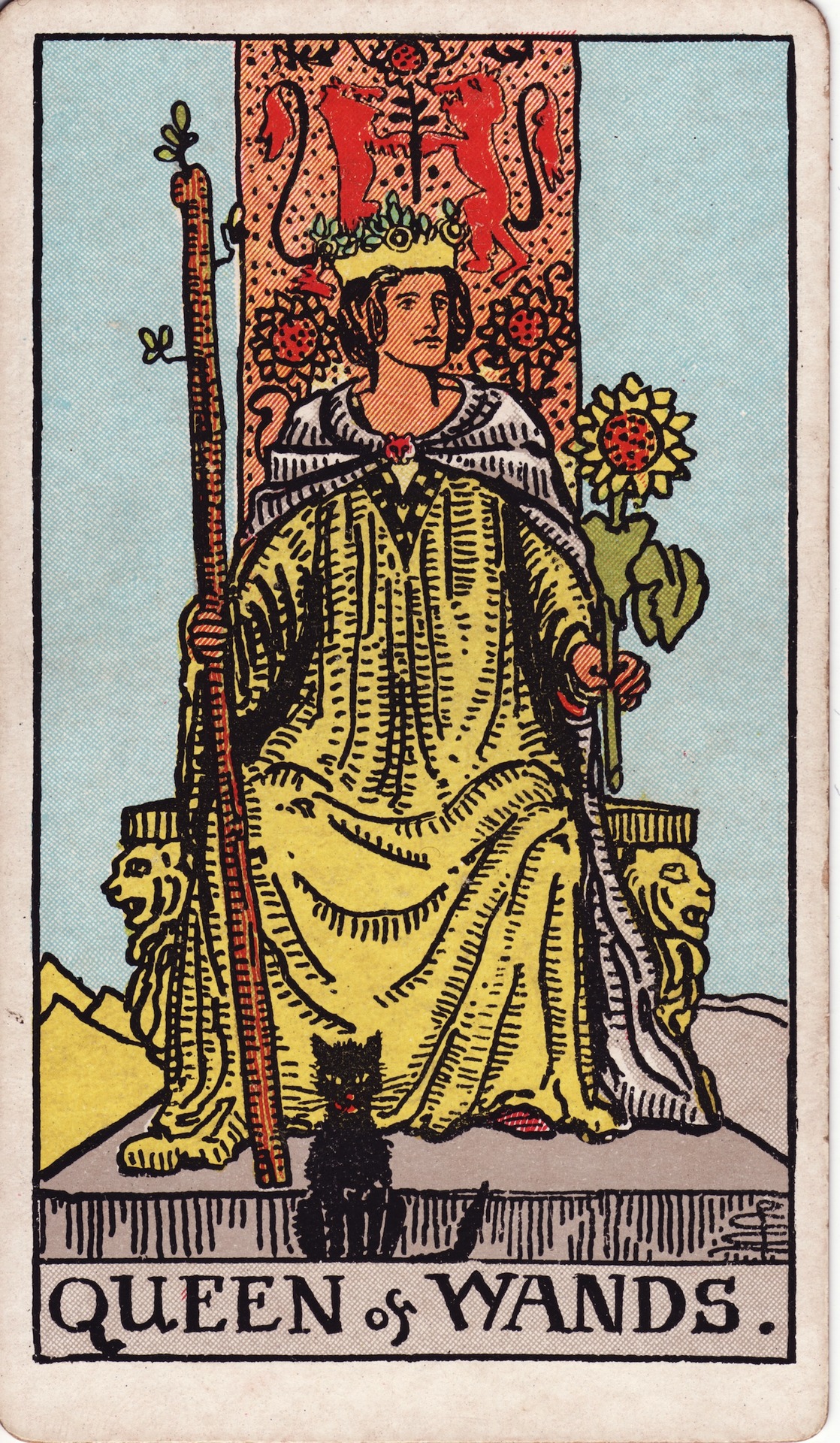
Waite-Smith imagery: The Queen sits on a throne, facing the viewer. The armrests of the throne are carved as lions, and the back of the throne is adorned with sunflowers and two red lions rampant facing each other. The queen wears a yellow robe, a grey mantle, and a golden crown adorned with leaves. She looks slightly to her left, her face at ease and possibly even lightly smiling. In her left hand, she holds a sunflower. In her right hand, she holds a staff with leaves sprouting from the top. A black cat sits in front of the throne and the dais. Sand dunes rise in the background under a clear blue sky.
Concept: Unlike the Knight, the Queen’s passions tend to solve problems instead of creating them. She is fearless like the Knight, but her fearlessness isn’t the courage of charging in without ever backing down: instead, it is the quiet courage of seeing the good in even the harshest environment and determinedly refusing to lose sight of the things that bring her joy. She doesn’t shy away from justice, and she still takes control because she knows that if something must be done, she wants to see that it is done right, and because she sees the goodness in all living things and trusts her intuition to nurture her passion, she naturally instills trust from others in her to do things correctly.
In a reading: When you see the Queen of Wands in a reading, it’s often a sign to take heart; letting your will guide your passions will pay off, even if not exactly in all the ways you expect. The Queen of Wands represents an optimistic outlook – not a hand-waving approach of “everything will be fine,” but rather the idea that whatever obstacles you might face, you have it in yourself to be brave and determined enough to overcome them if you can summon the will. This card isn’t about blind optimism; it’s a call to set high standards because you believe you can meet them. The black cat is often a symbol of intuition, and it appears prominently on this card; seeing this card in a reading may signal that you need to trust in yourself a little more – cats do care deeply about their human partners’ approval, but they don’t seek it the same way dogs do; they are self-assured and seek mutual trust rather than validation.
A helpful focusing affirmation: “I have the right to feel joy, even in times of hardship; I let my passions light the way forward instead of waiting for my circumstances to improve.”
The King of Wands
Keywords: Broad View, Leadership, Conquest

Waite-Smith imagery: The King sits on a throne, facing to the (viewer’s) left. In his right hand, he holds a staff with sprouting leaves, grounding it in the sand in front of the dais. His left arm moves back his robe, as if he is preparing to stand. He wears a red robe, a golden crown of flames, and a green mantle with a golden chain. The train of his robe is gold, and patterned with images of a salamander chasing its own tail. The same image appears on the back of his throne, along with lions rampant and emergent. A salamander stands beside the throne on the dais. The background is a desert landscape under a clear blue sky.
Concept: The King is the culmination of passion: he rules purely through his will. His conquest is not won through the clash of arms, but through the quiet strength of experience. Where the King of Swords is the architect, the King of Wands is the builder. He has gained full mastery over fire and has learned how to harness it without letting it consume him and others around him. He directs and leads, but he is also fully prepared to rise from his throne and directly step in where he is needed. He sees the bigger picture but is ready to stand and trek into the unknown once again if the opportunity presents itself.
In a reading: Seeing the King of Wands in a reading is a good opportunity to assess where you have overcome challenges recently, and just as importantly, what role your passion and will played in overcoming those challenges. The same energy you harnessed in those cases may be needed now, especially if others are looking to you for guidance and leadership. When you see the King of Wands in a reading, it may also be a sign to step back and look at the bigger picture rather than letting yourself become fixated on one particular element of your current goal. Is the task you’re facing truly a task that only you can do, or can you delegate parts of it to others? Consider how your current responsibilities can be delegated so they don’t overwhelm you, but on any account, be ready to do what has to be done to see your goals through.
A helpful focusing affirmation: “Only my own passion can bring about my vision; others may share my passions and help, but to see my goals through, I must direct those passions.”
Conclusion
The suit of Wands is all about passion, drive, and inner fire. Probably more than any other suit in the deck, Wands are all about action. They speak to all that can happen when your actions are governed by passion, both good and bad. Passion and desire are necessary things to accomplish your goals; you won’t get what you want by sitting around thinking about it and praying for it and waiting for the universe to just hand it to you. The common maxim that may best describe the suit of Wands is, “if you want something done, you have to do it yourself,” but there are a number of caveats, because the suit of Wands is also filled with themes of collaboration with others.
“Doing it yourself” doesn’t mean that you should never rely on others; if you try to take on everything on your own, you often leave yourself weighed down and burned out. The ending of the story of Wands isn’t like the bleak tragedy of Swords, but it’s still a word of warning: pyrrhic victories can be just as painful as outright defeats. Mastering your passions means understanding when you have to step in and take the reins, and just as importantly, when you need to let others take up the task. The important thing is that your vision is what is directing the efforts, and that means that you have to be a leader, not just a boss – and you can’t lead the way on a project or idea that you don’t believe in. Wands are all about finding the conviction and harnessing it.
That concludes part III of this guide! Next time, we will be looking at the ever-flowing feelings and emotions of the suit of Cups, so stay tuned for that in part IV.


No comments:
Post a Comment